Tuesday, April 24, 2007

Remembering Nishit Saran


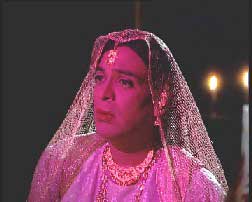
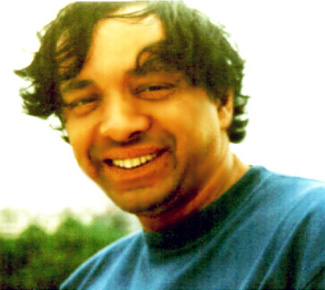
Nishit Saran died this day five years ago at the age of 26. He was a trailblazing filmmaker and is an inspiration to queer communities everywhere.
Born and raised in India, he moved to the US in 1994 for studies. Graduating with the highest honours in film from Harvard University in 1998, Saran was then awarded a prestigious teaching fellowship and a grant to make his first film. In 1998-99, Saran taught a year-long course in advanced filmmaking at Harvard, and also finished the making of ‘Summer in My Veins’, at the age of 23.
A personal documentary made with just a hand-held camera, it won high praise for its frank portrayal of Saran’s own struggle to reconcile his family ties and his homosexuality. The film has been screened at many international film festivals including Boston, Los Angeles, Toronto, San Francisco, Hawaii, New Zealand, and at both, public and private screenings in India. It was shown at what may well have been India’s first gay and lesbian festival, ‘Glitter & Gumboots’, organized by Delhi’s Lady Shri Ram College.
In May 1999, Saran returned to India to work on his next film. His first feature was ‘A Perfect Day’, an experimental film, 80 minutes in length, with a largely improvised script and minimal lighting that ignored many of the values of Bollywood; it was also India’s first digital feature film. It was shown at the ITC Digital Talkies International Film Festival in March 2001, besides other festivals. Saran also made ‘Project Flower’ on street children in Nizamuddin, New Delhi, which premiered at the World AIDS Conference in Durban.
Saran was outspoken in his support for gay rights in India and contributed articles, reviews, and essays to numerous national publications and webzines, including the strident editorial, ‘My sexuality is your business’ in ‘The Indian Express’ of 8 February 2000, which attacked Section 377 of the Indian Penal Code. Incidentally, he had been an editorial intern at his college magazine. (The Nishit Saran Foundation, run by the wonderful and brave Minna Saran and other family and friends, hosts some of his writings and photographs.)
Saran was researching Lord Shiva and the practice of Tantra for his next film project, when he passed away in a terrible car accident.

Sunday, July 02, 2006

Marching with pride

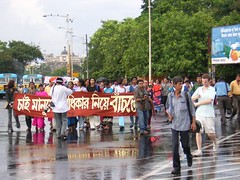
DSCN0416

Alternate sexualities. Everyone pretends we don't exist. Like the air we breathe. Breathe in, breathe out. You are not conscious of it. Maybe you don't want to be. Remember this song? But don't sing it--speak it: Kuch na kaho, kuch bhi na kaho. Kya kehna hai, kya sun-na hai. Tumko pata hai, mujhko pata hai. Samay ka ye pal tham sa gaya hai.
Time--at least the law--has stood still. Aren't more than A Hundred Years of Locking Us in the Closet Enough! An obnoxious British Raj law that criminalizes people of the same sex for loving each other, Section 377 of the Indian Penal Code, stands on the books. Meanwhile the rest of India prides itself on being a sovereign, democratic republic, even the world's largest democracy. Human rights? Yes, but only custom-fit, convenient ones only please--we are Indians! Shame on you, Heterosexual India.
Hate begets hate, love returns manifold. Nafrat karengay, nafrat milegee; pyar karengay, dugnaa milegaa. Sun le tu dil kee sadaa, pyar se pyar sajaa.
Thirty per cent of the population is NOT heterosexual. Family: You, mummy, papa, dada, dadi, nana, nani. Wake up and smell the coffee, at least one of you IS gay or bisexual. Queer India, it's time to come out wherever you are and face yourself in the mirror. Breathe the air, feel it in your lungs. No more hiding; it's Truth AND dare. The truth shall set you free. Satyamev Jayate!
The Pride march this year started from the statue of Mahatma Gandhi near the maidan and ended at Rabindra Sadan. But this march of self-affirmation shall go on, until India Shame becomes India Shining: "Where the mind is without fear and the head is held high..."
Agay bhi hoga jo uska karam, yeh din to manayenge har saal hum. This march of self-affirmation shall go on, for we have promises to keep to our forebears and miles to go before India Shame becomes India Shining:
Pictures from my second Pride march can be found on the links below. The first march in which I took part was also the first ever in India and again in Kolkata, in 1999.

My set of Pride march 2006 photos

The same set of pics is also on my Yahoo! 360 page

Friday, May 19, 2006

Banned, banned and banned again!

Edwin Fernandes in The Pink Mirror
A still from Gulabi Aaina

Like Jesus Christ is said to have told Peter, ‘Before the cock crow, thou shalt deny me thrice’, the Indian Censor Board in Delhi has banned Sridhar Rangayan’s film on drag queens thrice over.

While in April 2003 the censor board refused ‘Gulabi Aaina’ (The Pink Mirror) a certificate because it is “full of obscenity and vulgarity”, recently in April 2006, the board has done a complete change of tack to keep the film in the closet! The revising committee and the second revising committee refused it a certificate because in their opinion “the film Gulabi Aaina deals with an extremely complex issue of alternate sexuality in a peripheral manner”. Further, the board’s order states, “The problems and isolation faced by transvestites has not been dealt with in a holistic manner. Thus the film is refused certification as per relevant provisions of Cinematograph Act 1952”.

No, there’s no need to be happy or shocked that our esteemed State-appointed gatekeepers of art have discovered that most Indian filmmakers, when they are not invisibilizing homosexuality, are making fun of it. Theirs is neither a response to the ‘Girlfriend’ shock or to the ‘My Brother Nikhil’ balm. At worst it is an insidious, invidious game plan to keep a movie that makes no bones about same-sex desire and its natural ness with loads of humor hidden from the public gaze. At best, it is the sheer arrogance of an ignorant lot with no idea about the medium or the subject giving short shrift to the intelligence of both the audience and the filmmaker.

Sridhar is justifiably enraged and ready to join battle. He is planning to fight it out by taking the issue to the tribunal. (Also, see his comments below on the guidelines under which the committee reviewed the film and rejected it.) Fighting a battle for three years to get his film reviewed by the Board, Sridhar says he came across several skeletons in the censor board’s cupboard: “From those who write censor scripts, but actually offer their services as touts to get the film passed by censors to filmmakers who add six scenes of violence so that the censors can cut three and pass it. I even found out from reliable sources that a recent, acclaimed gay film was passed by the Censor Board on payment of certain monies.”

While Sridhar does praise the Board’s chairperson Sharmila Tagore and the regional officer at Delhi who “at least gave the film a fair chance by putting it up for review”, he is critical of the revising committee: “It was ridiculous sitting in front of six people and having to explain why I made the film and what I have tried to say in the film. If I could say it all verbally, then why did I have to use a visual medium like film!

“Peripheral and not holistic?! What do they expect me to say in 40 minutes, which is the length of my film. Moreover, ‘Gulabi Aaina’ is not a documentary. I wanted it to be an entertainer, but layered with subtext. When you do a film about gays, everyone expects a preachy message or a downright maudlin tearjerker. I wanted the audience to laugh with the characters instead of at them. Isn’t that good enough reason to make the film and have it reach viewers? It’s a different way of sensitizing.”

The Board really takes the cake and the pudding for implying that Sridhar’s film is insensitive to the problems faced by what it calls “transvestites”. In fact, that requires a vast stretch of imagination considering that Sridhar has been one of the forbearers of the gay rights movement in Bombay, being deeply involved with 'Bombay Dost' and The Humsafar Trust. It’s like calling Arjun Singh insensitive to the plight of OBC students (In Singh’s case, we are not sure whether his sincerity is for the OBC cause or to his own political survival).

The feckless, hypocrites in the committee after all the 'tamasha' of interrogating Sridhar about the film didn’t have the balls to pass the film. Says he, “They pretend they are broadminded, but when it comes to films with an alternate take, they cower. Basically, I have realized they wanted my characters to cry over their fate. They didn’t take too kindly to the fact that I showed gays and drag queens happy with their lives and being unapologetic. They wanted a daily soap with buckets of tears!” If Ekta Kapoor was looking for 'chamchas', she would have found them there.

Sridhar Rangayan color
Sridhar Rangayan

Meanwhile, Sridhar is looking for your support, especially if you are from the film fraternity and/or the gay community: “My fight is about freedom of expression as a filmmaker, and I damn well know how to use it sensitively and sensibly.”

Thankfully, Sridhar’s latest film ‘Yours Emotionally!’ has been produced by a UK based production house so no going through the sicko censors this time!


Crafty Censors

Instead of protecting the citizens, more often the State uses the law to terrorize them and curb their rights. Our censorship guidelines have also been similarly twisted to restrict free speech and discussion of homosexuality.

While an in-depth look at the guidelines is needed, Sridhar gave his responses to some of the guidelines under which the committee reviewed ‘Gulabi Aaina’ and rejected it:

- The medium of film remains responsible and sensitive to the values and standards of society.
“Nowhere is it mentioned what are these great values and standards of the society that they talk about. It is all a thick cloud in the air that the moral policemen comfortably hide under.”

- Artistic expression and creative freedom are not unduly curbed.
“But that’s exactly what they are doing by banning my film. It’s utterly ridiculous!”

- Certification is responsive to social change.
“If they keep refusing certificate to films that are away from the mainstream and attempt to discuss alternate issues, how do they expect any social change to happen? All they want is to maintain a status quo so that none of them will be blamed for taking an issue forward. It’s the who-wants-to-bell-the-cat syndrome.”

- The medium of film provides clean and healthy entertainment.
“Just look at all the masala films and skin flicks that get the Censor’s nod. Calling it clean and healthy entertainment is a big joke. Take a reality check folks!”

- As far as possible, the film is of aesthetic value and cinematically of good standard.
“My film has been screened at 57 international film festivals and won Jury Awards for Best Film of the Festival in New York and France. Most of the reviews talk about the sensitive handling of the subject and it has been rated as ‘fabulous’, ‘compelling’, ‘unique’ and even ‘an excellent example of Indian cinema’ by a Spanish critic. An art historian at Ohio State University compared it to Shyam Benegal’s 'Mandi', saying it bridged the gap between ‘Fire’ and ‘Bombay Boys’ by “adding that breath of reality”. How much more aesthetic and cinematic value can I pump into the film to please the censors? Maybe I should include 5 grisly murders, 3 item numbers and a bevy of half-naked women!”

Thursday, April 06, 2006

Protesting on behalf of DIDs

That's displaced in development (or development-induced-displacement) according to this noteworthy post on Desicritics by Madhukar. My anger is not just about the fact that those being displaced have not received their due compensation -- this is land-grabbing by the State -- but also against the way in which the government used force in an attempt to break up a peaceful demonstration at Jantar Mantar. Just one more instance of police high handedness, you say? After all it's "jiski lathee uskee bhains". But does it mean one should not raise one's voice against it? If the government truly feared for Patkar's health, wasn't there a better time (instead of midnight) or a peaceful way of arresting her and other Narmada Bachao Andolan activists?
You may or may not agree with Medha Patkar's cause but as a commentator about this emotional piece on Patkar's protest says: "(she) deserves to be commended for following what her beliefs are. In today's world, few of us are unworldly, isn't it? We worship at the shrine of high-paying jobs, expensive acquisitions, 'practical decisions' in life like scorning an arts education in favor of science or MBA degrees. Medha Patkar is living her convictions. Which can't be easy on an empty stomach."
If you do care a bit about the cause of the DID though, I would urge you to follow Madhukar's advice in his piece linked above and at the very least sign this petition and write to the media condemning the police for their goondaism.

Saturday, March 25, 2006

The Farmer Prince


Img.0014
Originally uploaded by Nitin Karani.
The coming out of Manavendra Singh Gohil as a gay man--the only Indian royal to do so--has caused quite a stir in Gujarat (with news travelling as far as London), within the circles of the erstwhile princely families, and specifically in his native Rajpipla.
My friend Vivek Raj Anand has written a wonderful piece on Manav (as we call him) that can be read on the Gay_Bombay Yahoo! list.
Manav's life would make a wonderful subject for a film and a documentary may be in the works already.